
Math · Numbers, fractions & decimals
Fractions: Operations and Mixed Numbers
Estimated study time. Take the time you need.
Start here: key ideas
- Add or subtract only after naming equal-size parts.
- Multiply numerators and denominators, then simplify.
- Divide by multiplying by the reciprocal.
- Convert mixed numbers before multiplying or dividing.
- Estimate before accepting an answer.
What you’ll be able to do
- Find common denominators and simplify.
- Multiply, divide, and convert mixed numbers.
- Estimate to test reasonableness.
Use denominator meaning to choose the operation, then simplify and estimate.
No prior lesson is required; multiplication facts are reviewed within the examples.
Fractions name equal parts
A denominator tells how many equal parts make one whole; a numerator tells how many parts are selected. Equivalent fractions name the same quantity, such as 1/2 and 3/6. Multiply or divide numerator and denominator by the same nonzero number to rename without changing value. A fraction is simplified when numerator and denominator share no factor greater than 1.
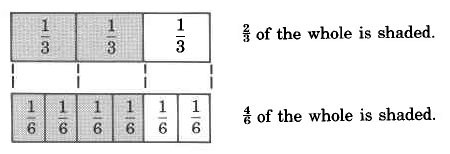
Denny Burzynski and Wade Ellis, Jr. / OpenStax CNX, via Mathematics LibreTexts · CC BY · https://math.libretexts.org/Bookshelves/PreAlgebra/Fundamentals_of_Mathematics_(Burzynski_and_Ellis)/04%3A_Introduction_to_Fractions_and_Multiplication_and_Division_of_Fractions/4.03%3A_Equivalent_Fractions_Reducing_Fractions_to_Lowest_Terms_and_Raising_Fractions_to_Higher_Terms · https://creativecommons.org/licenses/by/ · Source image reproduced unchanged.
Addition and subtraction
Fractions can be added only when their pieces have the same size. For 1/3+1/4, the least common denominator is 12: 4/12+3/12=7/12. Do not add denominators; twelfths remain twelfths. For subtraction, use the same process. If borrowing is needed, rename one whole as a fraction with the chosen denominator.
Multiply, divide, and convert
To multiply, multiply numerators and multiply denominators; cancel common factors first when convenient. To divide, multiply by the reciprocal of the divisor. Only the second fraction flips. A mixed number such as 2 1/3 means 2+1/3. Convert it to an improper fraction: (2×3+1)/3=7/3. Convert back by division.
Estimate with benchmarks 0, 1/2, and 1. A product of two positive proper fractions must be smaller than either factor. A quotient by a positive fraction less than 1 must be larger than the dividend.
Worked examples
Worked example 1: 2 1/4−5/6. Convert 2 1/4 to 9/4. The common denominator is 12: 27/12−10/12=17/12=1 5/12. The estimate 2.25−0.83≈1.42 supports the result.
Worked example 2: 1 1/2÷3/8. Convert to 3/2 and multiply by 8/3. Cancel the 3s: 8/2=4. Dividing 1.5 by a number below 1 should increase it, so 4 is reasonable.
A reliable way to reason
The least common denominator is efficient, but any common denominator works. For 5/6−1/4, using 12 gives 10/12−3/12=7/12; using 24 gives 20/24−6/24=14/24=7/12.
Division asks how many groups fit: 3÷3/4=4 because four groups of three fourths make 3. For mixed numbers, convert before multiplying or dividing; for addition or subtraction, keeping mixed numbers can be convenient unless borrowing is required.
Guided reasoning and error checks
For a multi-operation fraction expression, write one transformation per line. Consider 2/3+(3/4×2/5). Multiply first: 3/4×2/5=6/20=3/10. Then rename for addition: 2/3=20/30 and 3/10=9/30, so the total is 29/30. An answer above 1 would be suspicious because the estimate 2/3+3/10 is just under 1. This workflow separates the multiplication rule from the addition rule and makes the denominator choice visible.
Key terms
- numerator: The number of selected equal parts.
- denominator: The number of equal parts in one whole.
- equivalent fractions: Fractions naming the same value.
- least common denominator: The least common multiple of the denominators.
- mixed number: A whole number plus a proper fraction.
- improper fraction: A fraction whose numerator is at least its denominator.
- reciprocal: A fraction formed by switching numerator and denominator.
Summary
- Rename unlike fractions with a common denominator.
- Cross-cancel before multiplying when possible.
- Use a reciprocal only for division, and only on the divisor.
- Use benchmark fractions to check whether a sum, product, or quotient has a reasonable size.
Add needs same-size pieces; divide means multiply by the flipped second fraction.
Sources
Lesson checks
Reading is free. Starting checks uses your existing free-topic activity allowance; other assessment access rules still apply.
Reading on this device
This reading marker stays in this browser. It is not a saved account quiz result or mastery evidence.
Save your reading place
Reading progress is separate from quiz performance.
Create an account to save your reading or sign in. All lesson text stays available without signing in.More practice
Practice has its own access rules. It does not change access to this lesson.
See practice options