
Science · Scientific investigation
Experimental Design and the Scientific Method
Estimated study time. Take the time you need.
Start here: key ideas
- A hypothesis must be testable.
- The independent variable is changed by the researcher.
- The dependent variable is measured.
- Controlled variables are kept the same.
- A control group gives a comparison.
- Replication and good sampling strengthen evidence.
What you’ll be able to do
- Write a testable hypothesis.
- Identify independent, dependent, and controlled variables.
- Explain why controls, sampling, and replication matter.
- Tell validity from reliability.
Turn a question into a fair test by choosing variables, controls, samples, and repeated trials.
Know how to measure quantities and record units consistently.
From question to testable prediction
Science starts with an answerable question. A hypothesis is a testable proposed explanation or prediction. It should connect a change to a measurable result.
Example: “If light time increases, then bean plants will grow taller over two weeks.” This can be tested. “Plants like light” is too vague because “like” is not clearly measurable.
A hypothesis must be able to be supported or rejected with evidence. It is not a final proven fact. A prediction states the expected result if the hypothesis is correct.
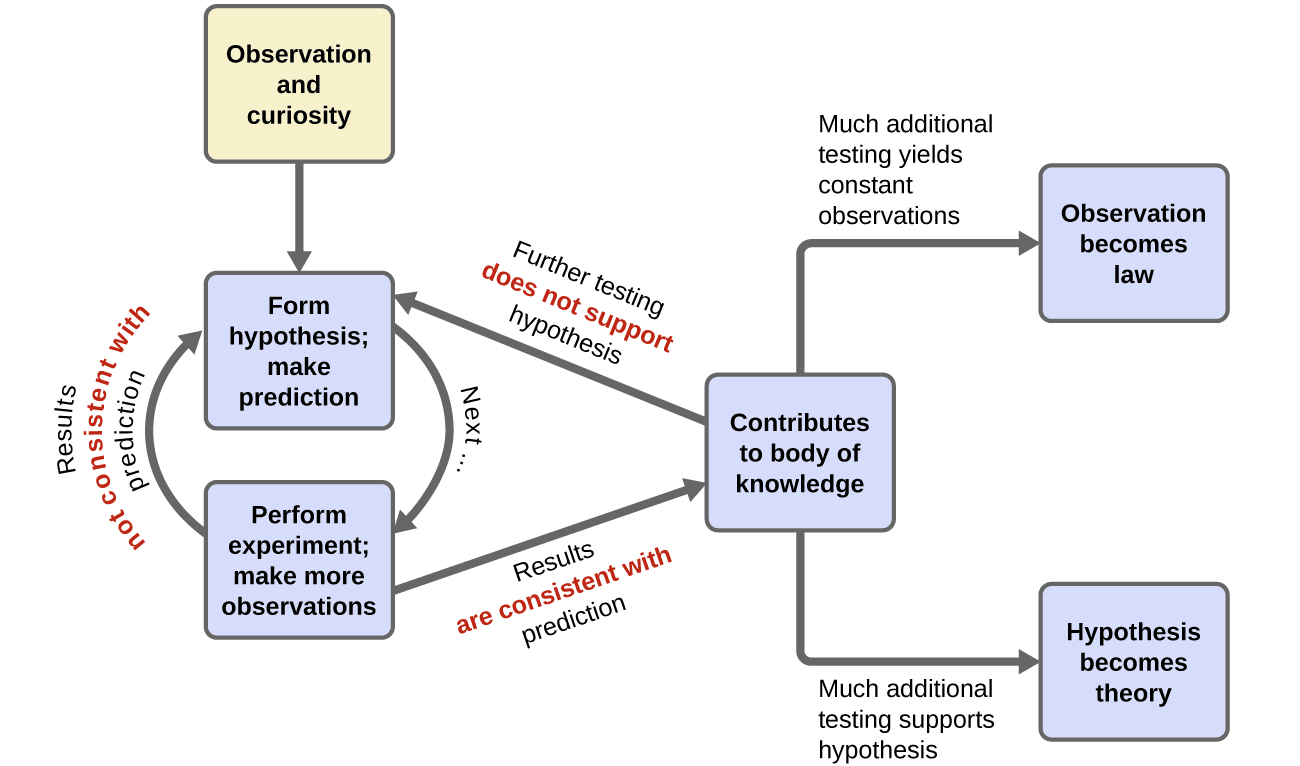
OpenStax College, Chemistry (CC BY archive) · CC BY 3.0 · https://github.com/philschatz/chemistry-book/blob/a6ac3918e61cbedf0589c5b43e748dc8a7edf5e2/resources/CNX_Chem_01_01_SciMethod.jpg · https://creativecommons.org/licenses/by/3.0/ · Original source image reproduced unchanged; explanatory caption added.
Identify what changes and what responds
The independent variable is the factor the researcher changes. The dependent variable is the response measured. Controlled variables are kept the same.
In the plant example, light time is independent and plant height is dependent. Plant type, soil, water, pot size, and study length should stay the same. Changing several factors at once makes the cause unclear.
Operational definitions state exactly how variables are changed or measured. “Growth” might mean change in height in centimeters over 14 days. This makes the test repeatable and prevents people from measuring different outcomes.
Samples, replication, and bias
A control group gives a comparison without the tested treatment. Random assignment helps spread hidden differences among groups. A larger, representative sample usually gives stronger evidence than a small biased sample.
Repeated trials show whether a result is consistent. Replication means other researchers can repeat the study. Blinding can reduce the effect of expectations on measurement.
Worked example. Divide similar plants randomly into no-fertilizer and fertilizer groups. Give all plants the same light, soil, water, and time. Measure height the same way. Several plants per group and repeated trials reduce the influence of chance.
Random sampling concerns who enters the sample and helps generalization; random assignment concerns which treatment sampled subjects receive and helps causal comparisons. Neither guarantees perfection. Repeated readings of one plant are not the same as independent replication with several plants.
Trust the right conclusion
Reliability means getting consistent results. Validity means the design truly tests the intended question. A tool can give very consistent but wrong readings, so reliability alone does not prove accuracy or validity.
A confounding variable changes with the independent variable and could explain the result. Good controls reduce confounding and support a cause-and-effect conclusion.
If a study changes fertilizer and water together, it cannot tell which change caused growth.
Key terms
- hypothesis: A testable proposed explanation or prediction.
- independent variable: The factor deliberately changed.
- dependent variable: The result measured.
- controlled variable: A factor kept the same.
- control group: A comparison group without the tested treatment.
- reliability: The ability to get consistent results.
- validity: How well a study tests the intended question.
Summary
- A useful hypothesis is testable.
- The independent variable is changed.
- The dependent variable is measured.
- Controls make comparison possible.
- Replication improves reliability.
- Validity asks whether the design tests the intended claim.
Change one main factor, measure the response, and keep other conditions the same.
Sources
Lesson checks
Reading is free. Starting checks uses your existing free-topic activity allowance; other assessment access rules still apply.
Reading on this device
This reading marker stays in this browser. It is not a saved account quiz result or mastery evidence.
Save your reading place
Reading progress is separate from quiz performance.
Create an account to save your reading or sign in. All lesson text stays available without signing in.More practice
Practice has its own access rules. It does not change access to this lesson.
See practice options