
Science · Cells, genes & microorganisms
DNA, RNA, and Protein Synthesis
Estimated study time. Take the time you need.
Start here: key ideas
- DNA stores instructions in its base sequence.
- A gene is a DNA section used to make a functional product.
- Replication copies DNA.
- Transcription makes RNA from DNA.
- Translation uses mRNA codons to build a protein.
- A mutation can change a protein, but it may also have no effect.
What you’ll be able to do
- Relate DNA, genes, chromosomes, and proteins.
- Put replication, transcription, and translation in order.
- Use base-pair rules.
- Predict a simple effect of a DNA change.
Follow genetic information from DNA to RNA to protein, then see how DNA changes may affect a product.
Know that the nucleus stores DNA and ribosomes build proteins.
Genes are functional regions of DNA
DNA stores biological instructions in the order of four bases: A, T, C, and G. A gene is a section of DNA used to make a functional RNA or protein. A chromosome is one long DNA molecule packaged with proteins.
Many proteins affect cell structure or chemical reactions. This creates a common path: DNA information leads to RNA, and RNA helps direct protein production.
A DNA nucleotide has three parts: deoxyribose sugar, phosphate, and one nitrogen base. Nucleotides join into a sugar-phosphate backbone. The bases point inward and pair A–T and C–G. This pairing lets either strand guide a matching copy.
Keep levels distinct. A chromosome is a packaged DNA molecule containing many genes. A gene is a DNA region whose expression produces a functional RNA or contributes to a protein product. A codon is only three bases in mRNA. One chromosome is not one gene, and one codon is not a whole protein instruction.
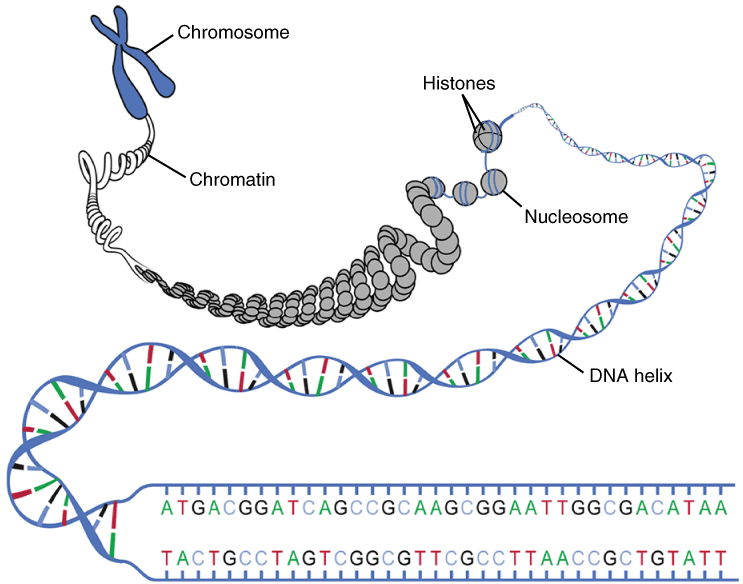
OpenStax College, Anatomy & Physiology (2014 CC BY archive) · CC BY 3.0 · https://github.com/philschatz/anatomy-book/blob/eadaa6b2992f4e4010f45d58ad4db065e398093e/resources/0321_DNA_Macrostructure.jpg · https://creativecommons.org/licenses/by/3.0/ · Original source image reproduced unchanged; explanatory caption added.
Replication copies DNA semiconservatively
Before a cell divides, replication copies its DNA. The two strands separate. Each old strand guides a new strand. A pairs with T, and C pairs with G.
Each finished DNA molecule has one old strand and one new strand. Enzymes proofread much of the new DNA, but an occasional change can remain.
Several enzymes cooperate during replication. Helicase separates the old strands. DNA polymerase adds matching DNA nucleotides and proofreads. Ligase joins short DNA pieces on the strand built in sections. Proofreading lowers errors but cannot remove every one.
Worked example. If an old strand reads A-C-G, the new DNA section reads T-G-C.
Transcription makes RNA
Transcription makes an RNA copy of a gene. RNA uses U instead of T, so DNA A pairs with RNA U. In eukaryotic cells, transcription occurs in the nucleus.
The finished messenger RNA, or mRNA, carries the instructions to a ribosome.
Supporting detail: RNA processing
In eukaryotes, the first RNA copy can contain sections called introns that are removed by splicing. The remaining sections join to form mature mRNA. A splicing error can leave an unwanted section in the message and change the protein instructions.
Worked example. DNA template TAC gives mRNA AUG because T pairs with A, A with U, and C with G.
Label the strand before converting. mRNA is complementary to the DNA template strand, but matches the coding strand except U replaces T. Template TAC gives AUG; coding ATG also corresponds to AUG when the sequences are shown in the stated directions.
Supporting sequence notation
The labels 3′ and 5′ show strand direction. Template DNA 3′-TAC-5′ produces mRNA 5′-AUG-3′. Directions should be supplied when a task needs them; do not reverse an unlabeled sequence by guessing.
Ribosomes translate codons
Translation happens at a ribosome. The ribosome reads mRNA three bases at a time. Each three-base word is a codon. Transfer RNA brings the matching amino acid.
The ribosome links amino acids into a chain. A start codon begins translation, and a stop codon ends it. The chain then folds into a working protein.
Each tRNA carries an amino acid and has an anticodon that pairs with an mRNA codon. If the anticodon cannot pair, the matching amino acid is not delivered efficiently. A stop codon does not name an amino acid; it tells a release factor to end the chain.
Worked example. For mRNA AUG-GCU-UAA, a codon chart gives methionine–alanine–stop.
Decode in a fixed sequence. Read mRNA from 5′ to 3′, separate it into codons from the stated start point, consult an mRNA codon chart, and stop at a stop codon. Anticodons belong to tRNA and pair complementarily with mRNA codons; a codon chart normally expects the mRNA codon, not the DNA triplet or tRNA anticodon.
| mRNA codon | Meaning |
|---|---|
| AUG | methionine/start |
| GCU | alanine |
| UUU | phenylalanine |
| UAA or UAG | stop |

OpenStax College, Anatomy & Physiology (2014 CC BY archive) · CC BY 3.0 · https://github.com/philschatz/anatomy-book/blob/eadaa6b2992f4e4010f45d58ad4db065e398093e/resources/0328_Transcription-translation_Summary.jpg · https://creativecommons.org/licenses/by/3.0/ · Original source image reproduced unchanged; explanatory caption added.
Sequence changes can alter products
A mutation is a change in DNA. A substitution changes one base. An insertion adds a base, and a deletion removes one. Insertions and deletions can shift how later codons are read.
A mutation may change one amino acid, stop a protein early, or have no effect because more than one codon can name the same amino acid. Its effect depends on where the change occurs.
Changing one base is a substitution. It can be silent, change one amino acid, or create a stop. Adding or removing one base shifts the reading frame and can change many later codons. Adding or removing exactly three bases may add or remove one amino acid without shifting later codons.
Example: deleting one base near the start usually has a larger effect than a silent substitution near the end because more later codons can change.
Key terms
- gene: A DNA section that contains instructions for a functional product.
- replication: Copying DNA before cell division.
- transcription: Making RNA from a DNA template.
- translation: Using mRNA instructions to build a protein.
- codon: A three-base mRNA word.
- mutation: A change in a DNA sequence.
- ribosome: The structure that builds proteins from mRNA instructions.
Summary
- Genes are sections of DNA on chromosomes.
- Replication copies DNA before division.
- Transcription makes RNA from DNA.
- Translation reads mRNA codons at a ribosome.
- Mutations may change a protein or may have no effect.
DNA stores, RNA carries, ribosomes build. This is the usual flow, though some viruses can copy RNA back into DNA.
Sources
Lesson checks
Reading is free. Starting checks uses your existing free-topic activity allowance; other assessment access rules still apply.
Reading on this device
This reading marker stays in this browser. It is not a saved account quiz result or mastery evidence.
Save your reading place
Reading progress is separate from quiz performance.
Create an account to save your reading or sign in. All lesson text stays available without signing in.More practice
Practice has its own access rules. It does not change access to this lesson.
See practice options