
Science · Regulation & defense
Endocrine System and Hormonal Control
Estimated study time. Take the time you need.
Start here: key ideas
- Hormones travel in blood but affect only cells with matching receptors.
- Peptide hormones use surface receptors; steroid hormones usually use receptors inside cells.
- Negative feedback controls most hormone systems.
- Insulin lowers blood glucose; glucagon raises it.
What you’ll be able to do
- Match major glands, hormones, targets, and effects.
- Compare peptide and steroid signaling.
- Apply feedback to glucose, thyroid, stress, and water balance.
Learn a small set of hormone maps, then use feedback to predict what changes next.
Negative feedback opposes a change and helps restore a working range.
Glands, hormones, targets, effects
Endocrine glands release hormones into blood. A hormone is a chemical message. Only a target cell with the matching receptor can respond. The pancreas releases insulin when blood glucose is high and glucagon when it is low. The thyroid releases thyroid hormone, which raises metabolic activity in many tissues. The parathyroid glands release PTH when blood calcium is low.
The hypothalamus connects nervous and endocrine control. It directs the pituitary. One pituitary signal, TSH, tells the thyroid to release thyroid hormone. Another, ACTH, tells the adrenal cortex to release cortisol during a longer stress response. The adrenal cortex also makes aldosterone, but aldosterone is controlled mainly by blood pressure, blood sodium, and blood potassium signals. The posterior pituitary releases ADH made by the hypothalamus; ADH helps the kidneys save water.
Separate synthesis from storage and release. Hypothalamic neurons synthesize ADH and oxytocin; their axons carry the hormones to the posterior pituitary, which stores and releases them. By contrast, the anterior pituitary synthesizes its own hormones in response to hypothalamic signals. For any endocrine question, identify source, release site, target, receptor location, and feedback effect as separate steps.
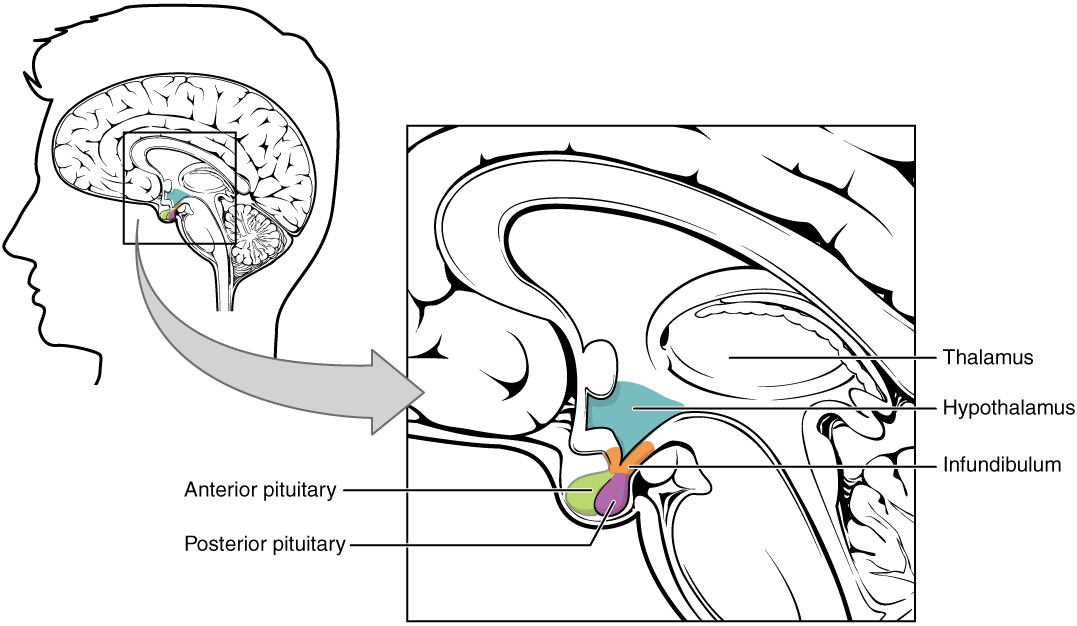
OpenStax College, Anatomy & Physiology (2014 CC BY archive) · CC BY 3.0 · https://github.com/philschatz/anatomy-book/blob/eadaa6b2992f4e4010f45d58ad4db065e398093e/resources/1806_The_Hypothalamus-Pituitary_Complex.jpg · https://creativecommons.org/licenses/by/3.0/ · Original source image reproduced unchanged; explanatory caption added.
Receptor location shapes the pathway
Water-soluble peptide hormones cannot easily cross the cell membrane. They bind surface receptors and start a relay inside the cell. Lipid-soluble steroid hormones cross the membrane and usually bind receptors inside the cell, changing gene activity. Both can have strong effects; receptor location is the key difference.
Surface-receptor signaling often uses second messengers and can change existing proteins quickly. Intracellular receptors often change which proteins a cell makes, so their effects may begin more slowly and last longer. A cell without the receptor does not respond even when the hormone passes nearby in blood.
Glucose and thyroid loops
After a meal, high blood glucose causes pancreatic beta cells to release insulin. Cells take up glucose, and the liver stores some as glycogen, so glucose falls. Between meals, low glucose causes alpha cells to release glucagon, which raises it. In the thyroid loop, pituitary TSH stimulates thyroid hormone. Rising thyroid hormone then reduces earlier signals by negative feedback.
Feedback questions often start with a damaged gland. If the thyroid cannot make enough hormone, negative feedback on the pituitary decreases, so TSH usually rises. If excess thyroid hormone comes from outside the gland, feedback increases and TSH usually falls. Work backward through the loop instead of memorizing isolated values.
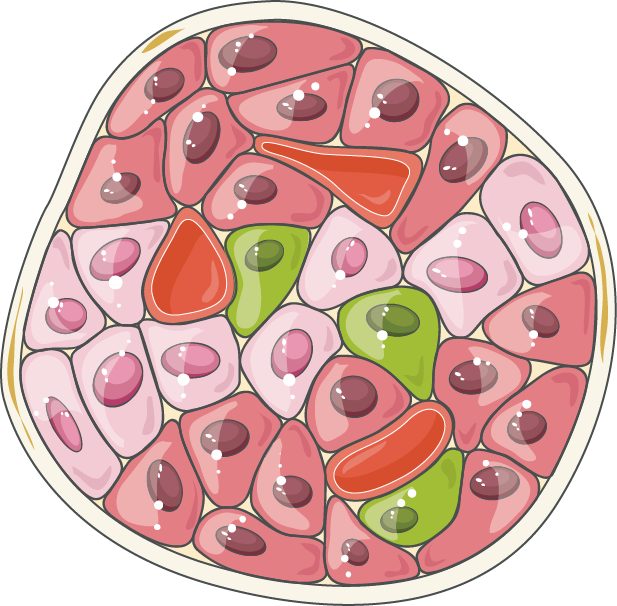
Servier Medical Art by Les Laboratoires Servier · CC BY 4.0 · https://smart.servier.com/smart_image/smart-islet-of-langerhans/ · https://creativecommons.org/licenses/by/4.0/ · Original source image reproduced unchanged; explanatory caption added.
Stress, water, and coordinated control
Stress signals can release epinephrine for a fast response and cortisol for a slower, longer response. When blood becomes too concentrated, ADH makes kidney collecting ducts reabsorb more water, so urine volume falls. Aldosterone increases sodium reabsorption; water often follows sodium. Always trace stimulus → hormone → target → effect → feedback.
Worked example: Dehydration makes blood more concentrated. Receptors in the hypothalamus detect the change. ADH release rises. Kidney collecting ducts reabsorb more water, leaving a smaller volume of concentrated urine. Added water lowers blood concentration, so the ADH signal later decreases.
Key terms
- hormone: A chemical messenger carried in blood.
- target cell: A cell with a receptor for a hormone.
- pituitary gland: A gland that releases hormones controlling several targets.
- insulin: A pancreatic hormone that lowers blood glucose.
- glucagon: A pancreatic hormone that raises blood glucose.
- ADH: A hormone that helps kidneys conserve water.
- negative feedback: Control in which a response reduces the original change.
Summary
- A hormone affects only target cells with the right receptor.
- Insulin and glucagon have opposite effects on blood glucose.
- Most endocrine loops reduce the signal once the needed effect occurs.
The hormone is the message; the receptor is the lock that decides which cell can read it.
Sources
Lesson checks
Reading is free. Starting checks uses your existing free-topic activity allowance; other assessment access rules still apply.
Reading on this device
This reading marker stays in this browser. It is not a saved account quiz result or mastery evidence.
Save your reading place
Reading progress is separate from quiz performance.
Create an account to save your reading or sign in. All lesson text stays available without signing in.More practice
Practice has its own access rules. It does not change access to this lesson.
See practice options