
Science · Cells, genes & microorganisms
Microorganisms, Disease, and Transmission
Estimated study time. Take the time you need.
Start here: key ideas
- Bacteria are cells; viruses are not cells.
- Fungi and protozoa are eukaryotes.
- A pathogen causes disease, but many microbes are harmless or helpful.
- Disease spreads through a chain of connected steps.
- Antibiotics treat bacteria, not viruses.
- Resistance becomes common when resistant microbes survive and reproduce.
What you’ll be able to do
- Compare bacteria, viruses, fungi, and protozoa.
- Explain the chain of infection.
- Choose prevention steps for a route of spread.
- Explain basic antibiotic resistance.
Compare major microbe groups, trace disease spread, and connect prevention or treatment to the correct target.
Know that the immune system protects the body from harmful agents.
Microbial groups differ in cellular organization
Bacteria are single-celled prokaryotes. Viruses are not cells and must use a host cell to reproduce. Fungi are eukaryotes such as yeasts and molds. Protozoa are single-celled eukaryotes.
These groups differ in structure, so one treatment does not work for all of them. Antibiotics target bacterial features and do not kill viruses.
Bacteria reproduce by cell division. Viruses cannot reproduce independently; their genetic material enters a host cell and directs the host to make viral parts. Fungi differ from bacteria in cell type and chemistry. Many fungal walls contain chitin, a tough material. Molds grow as tiny threads called hyphae. Many protozoa move through water or hosts.
| Category | Cellular organization | Replication clue |
|---|---|---|
| Bacterium | Prokaryotic cell | Can divide independently under suitable conditions |
| Virus | Acellular | Requires a host cell to make new viral particles |
| Fungus | Eukaryotic; yeast may be unicellular, molds multicellular | Own cellular reproduction |
| Protozoan | Single-celled eukaryote | Own cellular reproduction, often within a host life cycle |
| Helminth | Multicellular animal parasite | Life cycle may include microscopic eggs or larvae |
“Microbe” is a practical umbrella term here, not a claim that every member is a microscopic cellular organism. Viruses are acellular, and adult helminths may be visible even though microscopic stages are important in disease.
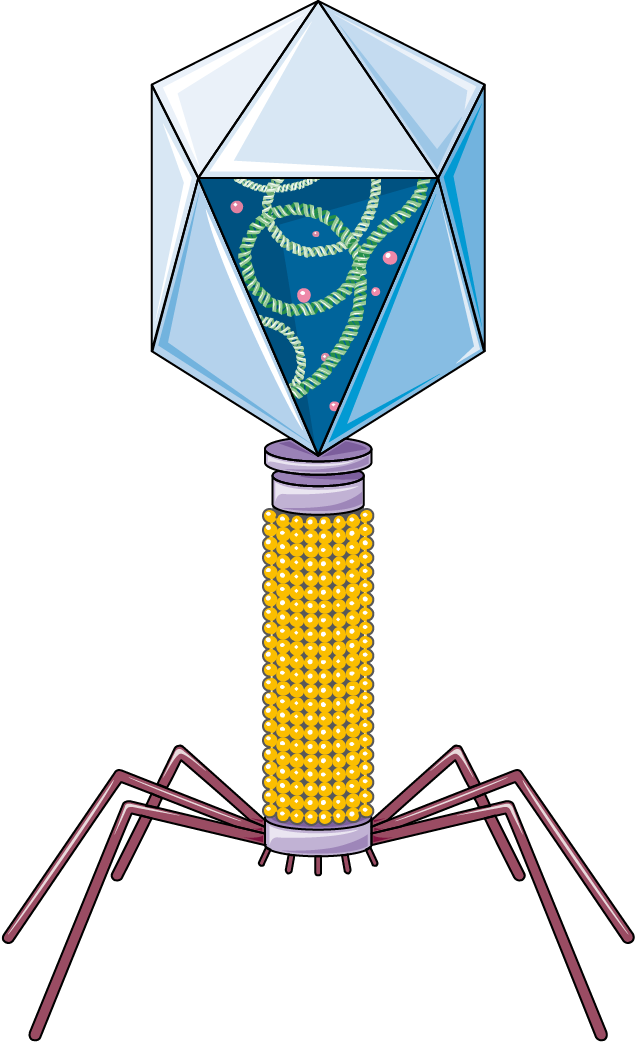
Servier Medical Art by Servier · CC BY 4.0 · https://smart.servier.com/smart_image/bacteriophage-virus/ · https://creativecommons.org/licenses/by/4.0/ · Source image reproduced unchanged; explanatory caption added.
Presence does not always mean disease
A pathogen can cause disease, but not every microbe is harmful. Many microbes normally live on or in the body without causing illness. Disease depends on the agent, the dose, the entry site, and the host’s defenses.
Infection means an agent has entered and multiplied. Disease means normal body function has been harmed. The two words are related but not identical.
An opportunistic pathogen usually causes disease when defenses are weak or when it enters an unusual body site. The same microbe can be harmless in one location and harmful in another. Symptoms alone do not identify the microbial group.
Transmission requires connected links
The chain of infection describes spread: agent, reservoir, exit route, transmission route, entry route, and susceptible host. A reservoir is where the agent lives. Transmission may occur by contact, droplets, food, water, or a vector.
Breaking one link can slow spread. Handwashing reduces contact spread. Safe food handling blocks foodborne spread. Covering coughs reduces droplets. Vaccination can reduce host susceptibility.
Worked example. A respiratory virus leaves an infected person in droplets and enters another person through the nose or mouth. Masks, ventilation, distance, and covering coughs act on this route. Cleaning shared objects matters more when indirect contact is important.
Keep the six links distinct: agent → reservoir → portal of exit → mode of transmission → portal of entry → susceptible host. An object such as a bed rail can be a vehicle for indirect contact, but it is not automatically the reservoir. A prevention step should be matched to the link named by the evidence rather than chosen from a memorized universal list.
Targets and resistance must be matched
Treatment must match the target. Antibiotics act on bacteria. Antiviral drugs act on parts of viral reproduction. Antifungal and antiprotozoal drugs target their own groups.
Resistance grows in a population when a few microbes can survive a drug and reproduce. The drug does not make them choose to adapt. Correct drug use helps reduce selection for resistant microbes.
A susceptible host is a person whose defenses cannot stop the agent. Age, immunity, vaccination, and health can affect susceptibility. A reservoir may be a person, animal, water, soil, or surface, depending on the pathogen.
When an antibiotic is used, susceptible bacteria die while resistant ones survive. The survivors reproduce, so resistance becomes more common.
Microscope choice depends on the question. A light microscope can observe living cells but has lower resolution than an electron microscope. Transmission electron microscopy reveals internal ultrastructure in thin prepared specimens; scanning electron microscopy emphasizes surface form. Electron microscopy requires prepared specimens in conditions incompatible with observing a living sample. No microscope image by itself proves that an agent caused a patient’s disease.
This lesson teaches classification and transmission reasoning only. It does not provide individual diagnosis or treatment instructions.
Key terms
- microorganism: An organism or infectious agent too small to see without magnification.
- pathogen: A microbe or agent that can cause disease.
- reservoir: A place where a pathogen normally lives or remains.
- transmission: The spread of a pathogen from one host or place to another.
- antibiotic: A medicine that acts against bacteria.
- resistance: The inherited ability of a microbe to survive a treatment.
Summary
- Bacteria are prokaryotic cells.
- Viruses reproduce only inside host cells.
- Fungi and protozoa are eukaryotic.
- Disease requires more than the presence of a microbe.
- Breaking a transmission link can prevent spread.
- Antibiotics do not treat viruses.
Break any link in the chain of infection to slow spread. The best link depends on how the pathogen travels.
Sources
Lesson checks
Reading is free. Starting checks uses your existing free-topic activity allowance; other assessment access rules still apply.
Reading on this device
This reading marker stays in this browser. It is not a saved account quiz result or mastery evidence.
Save your reading place
Reading progress is separate from quiz performance.
Create an account to save your reading or sign in. All lesson text stays available without signing in.More practice
Practice has its own access rules. It does not change access to this lesson.
See practice options