
Science · Chemistry foundations
Properties and Changes of Matter
Estimated study time. Take the time you need.
Start here: key ideas
- An element contains one kind of atom.
- A compound has elements chemically joined in a fixed ratio.
- Mixtures can be separated by physical methods.
- A physical change keeps the substance’s identity.
- A chemical change forms new substances.
- Heating usually increases particle motion.
What you’ll be able to do
- Classify elements, compounds, and mixtures.
- Tell physical properties and changes from chemical ones.
- Explain solid, liquid, and gas behavior with particles.
Classify matter, tell physical changes from chemical changes, and connect phases to particle motion.
Know that matter has mass and takes up space.
Pure substances and mixtures
A pure substance has a fixed composition. An element contains one kind of atom. A compound contains two or more elements chemically joined in a fixed ratio.
A mixture has substances physically combined in a variable ratio. A homogeneous mixture looks uniform, like salt water. A heterogeneous mixture has visibly different parts, like oil and water.
A compound cannot be separated into its elements by filtering or boiling because its atoms are chemically joined. A mixture can often be separated by physical properties. Filtration separates by particle size; distillation separates by boiling point.
What changes identity?
A physical property can be observed without changing identity, such as density or melting point. A physical change changes size, shape, or phase but not the substance itself.
A chemical change forms new substances. Strong clues include a lasting color change, gas or solid formation, or energy change. One clue alone is not always proof; use the full evidence.
Worked example. Ice melting is physical because it remains H2O. Iron rusting is chemical because iron reacts with oxygen to make new substances. Cutting iron is physical because only size and shape change.
Reason from sample size: a 54 g sample occupying 20 mL has density 54 ÷ 20 = 2.7 g/mL. Cutting it in half halves mass and volume, but not density at the same temperature. Properties that change with sample size are called extensive; properties such as density that do not are intensive. Focus on predicting the change, rather than memorizing the labels.
Particles and phase changes
Solid particles vibrate in fixed positions. Liquid particles stay close but move past one another. Gas particles are far apart and move freely.
Melting, freezing, boiling, condensation, sublimation, and deposition are phase changes. They are physical because chemical identity stays the same. Adding heat usually increases particle motion.
During melting, particles gain energy and overcome some attractions. During boiling, particles spread far apart. During freezing and condensation, particles lose energy and move less freely. For a pure substance at constant pressure, temperature stays steady during the phase change while energy changes particle arrangement. Mixtures and changing pressure need not behave this way.
Supporting diagram labels: phase boundaries
A phase diagram places temperature on the horizontal axis and pressure on the vertical axis. Regions show phases; boundary lines show conditions where two phases coexist. Three boundaries meet at the triple point. The liquid–gas boundary ends at the critical point. Above both critical temperature and critical pressure, a supercritical fluid has no separate liquid–gas boundary. That is not liquid and gas coexisting as separate phases.
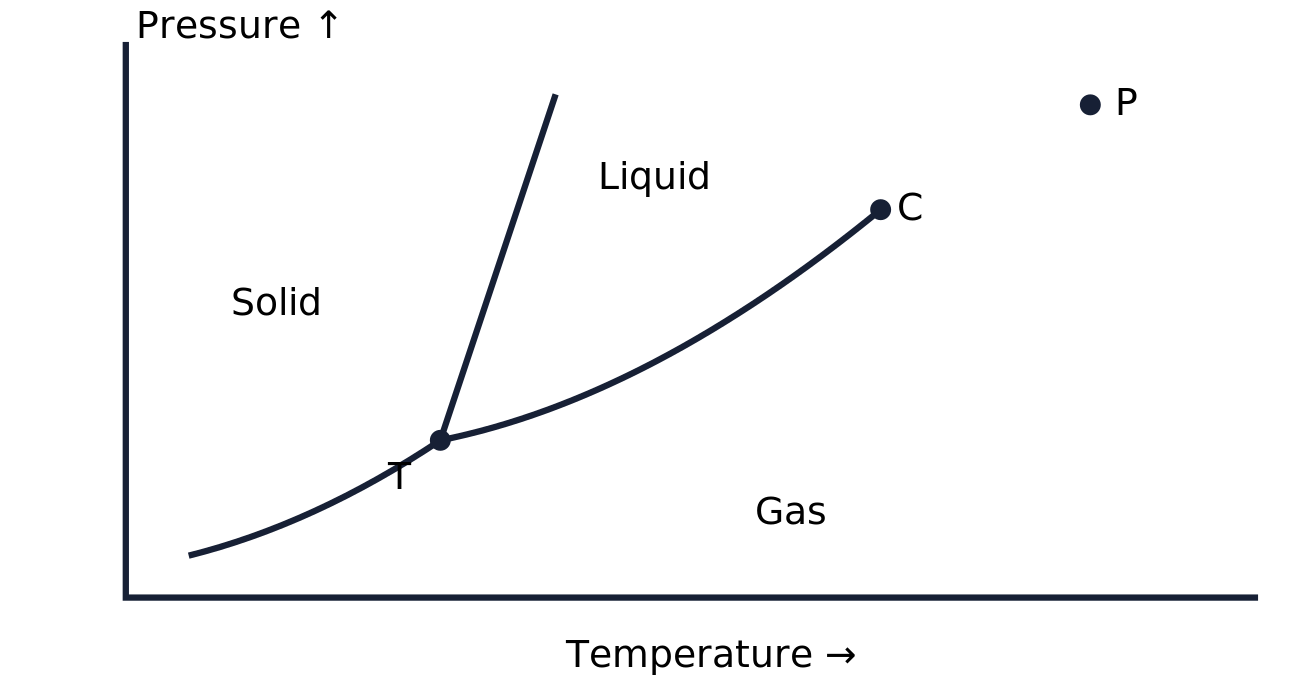
Read the diagram: T is where all three boundaries meet. C ends the liquid–gas line. Moving horizontally keeps pressure constant; moving vertically keeps temperature constant. The diagram is schematic, not a source of numerical transition temperatures.

OpenStax College, Chemistry (CC BY archive) · CC BY 3.0 · https://github.com/philschatz/chemistry-book/blob/a6ac3918e61cbedf0589c5b43e748dc8a7edf5e2/resources/CNX_Chem_01_02_StatesMatt.jpg · https://creativecommons.org/licenses/by/3.0/ · Original source image reproduced unchanged; explanatory caption added.
Key terms
- element: A pure substance made of one kind of atom.
- compound: Two or more elements chemically joined in a fixed ratio.
- mixture: Substances physically combined in a variable ratio.
- physical change: A change that does not form a new substance.
- chemical change: A change that forms one or more new substances.
- phase change: A physical change between solid, liquid, and gas.
Summary
- Elements and compounds are pure substances.
- Mixtures have variable composition.
- Physical changes keep chemical identity.
- Chemical changes form new substances.
- Phase changes are physical changes.
Physical changes keep identity; chemical changes create new identities.
Sources
Lesson checks
Reading is free. Starting checks uses your existing free-topic activity allowance; other assessment access rules still apply.
Reading on this device
This reading marker stays in this browser. It is not a saved account quiz result or mastery evidence.
Save your reading place
Reading progress is separate from quiz performance.
Create an account to save your reading or sign in. All lesson text stays available without signing in.More practice
Practice has its own access rules. It does not change access to this lesson.
See practice options